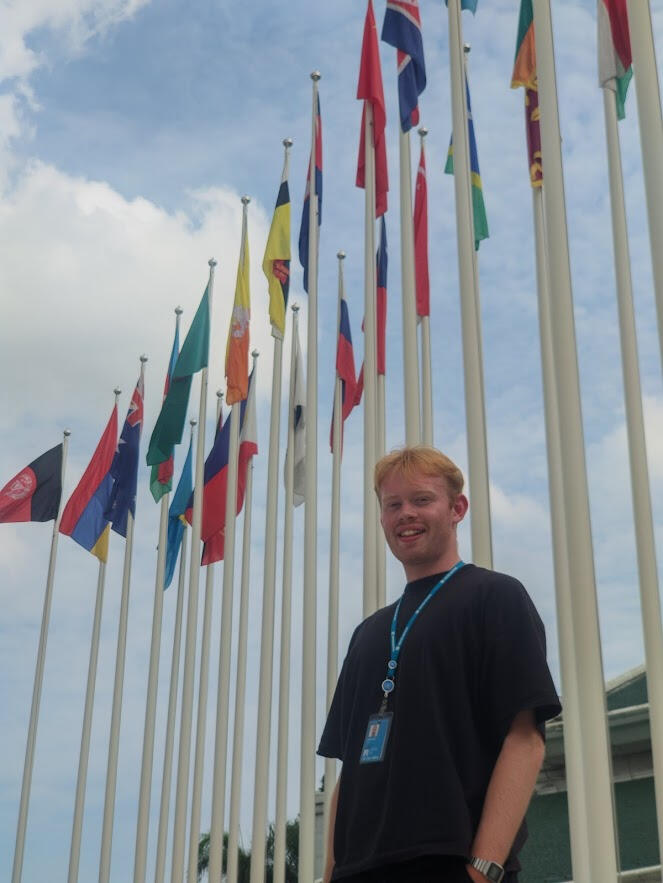
Hi, I'm Finn!
I’m a specialist Economics tutor for A Level and IB students.


I grew up on the Isle of Man, studied in Sheffield, and later worked for the UK Government and the United Nations in Economic Affairs.

I am now a full-time tutor to A Level & IB Economics students who want to excel in their exams.


Approach


I could tell you I tailor my teaching to every student — but the range of people I work with makes that hard to summarise meaningfully. However, there are three common denominators:

  • knowing exactly what examiners actually reward,

  • an honest diagnosis of where marks are being lost,

  • & no wasted time on things that don't move the needle.

Beyond that, what works for one student often looks nothing like what works for another. Use the checklist on the right and the below testimonials to see what my approach might look like for you.

Sound familiar?

0
Tick anything that applies to you.
const singleMessages = { evaluation: "Evaluation is the hardest mark to teach yourself — it needs a structural fix, not more content.", time: "Time pressure on data response is almost always a technique problem, not a knowledge one. There's a reliable way through it.", context: "Application is a skill in itself. Once you have a method for unfamiliar questions, they stop feeling unfamiliar.", diagrams: "Diagrams without narration get marked down even when they're correct. A small habit change fixes this fast.", essays: "Usually this means structure and signposting are the real issue — not knowledge. Examiners can't reward what they can't clearly follow.", examiner: "That's the most honest thing a student can admit — and the most useful starting point.", }; const multiMessages = [ { min: 2, msg: "These aren't random weaknesses — they tend to come from the same underlying gaps. Worth talking through." }, { min: 4, msg: "A lot of these are connected. Fixing one often moves several others. Let's find where to start." }, { min: 6, msg: "This is a full picture — and a fixable one. Get in touch and we'll work out where to begin." }, ]; function toggle(item) { const cb = item.querySelector('input'); cb.checked = !cb.checked; item.classList.toggle('checked', cb.checked); update(); } function update() { const checked = document.querySelectorAll('.check-item input:checked'); const count = checked.length; document.getElementById('count').textContent = count; const msgEl = document.getElementById('msg'); const ctaEl = document.getElementById('cta'); if (count === 0) { msgEl.textContent = "Tick anything that applies to you."; ctaEl.style.display = 'none'; return; } ctaEl.style.display = 'inline-block'; if (count === 1) { const id = checked[0].closest('.check-item').dataset.id; msgEl.textContent = singleMessages[id]; return; } let msg = multiMessages[0].msg; for (const m of multiMessages) { if (count >= m.min) msg = m.msg; } msgEl.textContent = msg; }


Outcomes

Four diverse success stories from the 24/25 academic year alone.

The Deficit
The Intervention
The Surplus
James (IB HL)

Indirect approach to 10 and 15-markers, leading to consistent timing issues.

Drilled a writing regimen focused on precision and concise essay planning.

Grade 7. Secured LSE placement after mastering exam timing.

Maryam (AQA)

Losing 8+ marks per essay. Analysis was descriptive rather than evaluative.

Developed high-level evaluation hooks: questioning the question, time lags, prioritisation, etc.

Grade A*. Essay scores hit 22/25 in 6 weeks.

Marcus (CIE)

Excelled in MCQ, but diagrams were weak. Relied on memorisation rather than simple derivation.

Relearned how to build diagrams from scratch to ensure accuracy under pressure.

Grade A. Remarkable Y13 results corrected a Y12 B to an A overall.

Priya (Edexcel)

Static Grade D. Overwhelmed by syllabus volume and poor exam technique.

Began two lessons per week with 9 weeks to go: balanced strategic exam technique with targeted content review.

Grade B. Rejected existing firm offer to upgrade to a Russell Group uni via Clearing.


Frequently Asked Questions

Which exam boards do you cover?

All of them—otherwise, I wouldn't call myself a specialist. Although they mostly overlap, it is critical to understand when and how the exam boards differ; primarily where content is added and exactly how they vary in their assessment styles.

Is it too late to start tutoring before exams?

It is rarely too late, but the strategy evolves. If we have months, I focus on building a deeper conceptual foundation. If we only have a few weeks, I place a much heavier emphasis on strategic exam technique. This involves navigating mark schemes and learning how to maximise points under pressure without losing sight of the core theory.

How is progress tracked?

I use timed essay segments and review past papers to identify exactly where marks are being lost. If a student is not receiving regular homework from school, I will set independent work to ensure they are applying what we cover in our sessions. I also enjoy providing brief updates to parents after major milestones or term breaks.

What is expected of the student?

Tutoring is a partnership, not a passive service. While I help provide strategy and clarity, the final result depends on the student's willingness to put in the work between sessions. I expect students to be engaged during our sessions and to complete any agreed-upon practice questions, as consistent independent effort is the primary driver of high performance.

What does my child need for lessons?

I teach via Zoom, so students just need a laptop/tablet (or both), decent Wi-Fi, and a quiet spot to work. Some students opt to take paper notes throughout lessons, but any material used or generated in lessons can be downloaded as an interactive PDF at the end of each session.

My child is struggling with the jump from GCSE to A-Level. Is this normal?

It is very common. As well as a lot more content, A-Level Economics requires deeper analysis (AO3) and evaluation (AO4) skills that GCSE simply does not demand. I focus on bridging this gap early, teaching students how to think like economists rather than just memorising facts.

What is the commitment?

High performance requires consistency. For this reason, I only accept students who are willing to commit to at least ten lessons. I do not take on sporadic or occasional assistance requests because they rarely lead to the results I aim for. Regarding payment, you can pay monthly or upfront in blocks for a small discount. Fill out the contact form or get in touch directly for current pricing.

Do you teach any other subjects?

I specialise exclusively in Economics to ensure the best possible results. However, I do teach GCSE Economics on request. For anything else, I am happy to point you toward trusted tutors in my network who specialise in those areas.


Got an Infrequently Asked Question?
You can:

+44 7555 037906

[email protected]

or fill out this form:


Book your Intro Call

Read enough? Want to see if we're a fit? Pick a meeting slot below to get the ball rolling with a free zero-obligation consultation call .